Melasma Laser Treatment: The Low-Fluence Protocol That Actually Works (2026)
Melasma is a chronic, relapsing pigmentary disorder — not a one-pass removal target. The protocol with the strongest safety record is low fluence + large spot size + repeated sessions, delivered alongside strict broad-spectrum photoprotection and topical maintenance. High-fluence, short-pulse “photoacoustic” settings that clear freckles or Ota’s nevus reliably trigger post-inflammatory hyperpigmentation (PIH) and rebound darkening in melasma. Expect 6–10 sessions spaced 2–4 weeks apart, with visible improvement typically from session 3–4, and plan for maintenance rather than a permanent cure.
Why Standard Pigment Settings Fail on Melasma
Melasma is not simply “more melanin in one spot.” Histologically it involves increased melanocyte activity, and a compromised basement membrane, and dermal melanosis, and increased vascularity. That combination is why a lesion that looks epidermal on the surface can behave like a mixed or dermal lesion under a laser.
When you deliver a high-fluence Q-switched pulse tuned for a freckle, the melanin absorbs enough energy to shatter melanosomes — and the surrounding melanocytes, already in a hyper-reactive state, respond by producing more pigment. The result is the classic clinical disaster: the patch clears for ten days, then returns darker than before.
Three mechanisms drive that rebound:
- Basement membrane disruption — allows melanin to drop into the dermis, converting an epidermal pattern into a durable mixed pattern.
- Inflammatory cascade — prostaglandins and other mediators stimulate neighbouring melanocytes.
- Vascular component — melasma lesions frequently show increased VEGF and vessel density; ignoring it leaves the trigger in place.
The Low-Fluence, Large-Spot Protocol
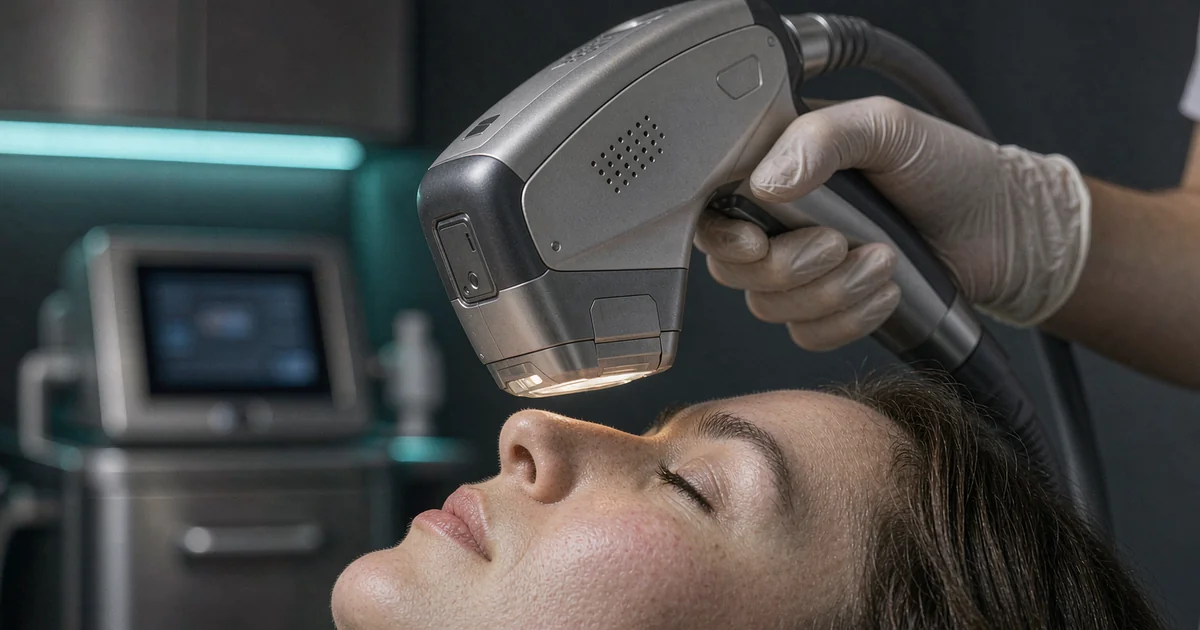
The core principle, often called “laser toning” or the “sub-threshold” approach: keep each pulse below the threshold that produces a visible immediate endpoint, and let repetition do the work across a course of treatments.
| Parameter | Q-Switched 1064 nm (toning) | Picosecond 1064 nm | Notes |
|---|---|---|---|
| Fluence | 1.6–3.5 J/cm² | 0.4–0.9 J/cm² | Start at the low end; titrate up only if no response after 2 sessions |
| Spot size | 6–8 mm | 6–10 mm | Large spot keeps energy distributed and depth more uniform |
| Pulse / repetition | 5–10 Hz, multiple passes | Multiple passes | Overlapping ~10–20% per pass |
| Sessions | 6–10 | 4–8 | Spaced 2–4 weeks apart |
| Endpoint | Faint, transient erythema only | Faint erythema only | No immediate whitening, no petechiae, no purpura |
The endpoint rule is the safety guardrail. If the treated area turns white (immediate epidermal whitening) or develops petechiae, the fluence was too high. Stop, drop the energy, and re-test on a different site at the next session.
Test Spots Are Non-Negotiable
Before the first full session, place 3–4 test spots along the jaw or pre-auricular area at ascending fluences. Review at 2 weeks. Treat the full face using the highest fluence that produced no PIH. This single step prevents the majority of severe rebound cases.
Device Selection: Toning, Picosecond, IPL, and What to Avoid
- Q-switched 1064 nm toning — the most widely documented approach for melasma; lowest cost per session; requires the most sessions.
- Picosecond 1064 nm with a diffractive lens array — shorter pulse width means less heat diffusion; useful when patients cannot tolerate QS toning; higher capital cost.
- IPL / BBL — can help the epidermal component, but filter selection and conservative fluence are critical; higher PIH risk in Fitzpatrick IV–VI. Not a first-line choice for dermal-predominant melasma.
- Avoid as monotherapy — 532 nm Q-switched, high-fluence QS 694 nm, and aggressive ablative resurfacing. All carry disproportionate rebound risk.
Course Design and Maintenance
- Prime (2–4 weeks before) — topical tyrosinase inhibitor, daily broad-spectrum SPF 50+, and visible-light (tinted) protection. Treating unprimed skin measurably raises PIH risk.
- Treat (6–10 sessions, 2–4 week spacing) — log fluence, spot, passes, and endpoint at every visit.
- Assess — photograph under identical lighting; use MASI or a simple 0–3 clinician grade. Do not judge on a single visit.
- Maintain — monthly or quarterly top-ups plus continuous photoprotection. Melasma relapses in a majority of patients within 12 months without maintenance.
Adjuncts That Change the Outcome
Laser alone underperforms. The evidence-supported adjuncts are:
- Topical — hydroquinone (cycled), azelaic acid, kojic acid, tranexamic acid (topical or oral where legally permitted), retinoids at night.
- Oral tranexamic acid — increasingly used for the vascular component; requires screening for thromboembolic risk and clear local regulatory clearance.
- Vascular targeting — low-fluence PDL or long-pulsed 1064 for the erythema component, sequenced before pigment work.
- Photoprotection — SPF 50+ with high UVA-PF, tinted to block visible light, reapplied. This is the single highest-leverage variable.
When Not to Treat
Defer treatment during pregnancy and lactation, within 4 weeks of significant sun exposure, in patients with recent isotretinoin use (assess individually), with a history of keloid formation, or with unrealistic expectations of a permanent cure. Document the relapse conversation before the first session — it protects the clinic as much as the patient.
Related reading
Frequently asked questions
Is melasma permanently curable with laser?
No. Melasma is a chronic relapsing condition. Laser and light devices reduce pigment load and improve appearance, but relapse is common without ongoing photoprotection and topical maintenance. Clinics should set this expectation before treatment begins.
Why does melasma get darker after laser treatment?
Rebound darkening is usually post-inflammatory hyperpigmentation triggered by excessive fluence. High-energy pulses disrupt the basement membrane and provoke an inflammatory cascade that stimulates melanocytes. Using sub-threshold fluence with no visible immediate endpoint greatly reduces this risk.
How many melasma laser sessions are needed?
Most protocols run 6–10 sessions at 2–4 week intervals for Q-switched 1064 nm toning, or 4–8 sessions for picosecond 1064 nm. Visible change usually appears from session 3–4. Maintenance sessions follow.
Which wavelength is safest for melasma?
1064 nm is preferred because it penetrates deeper and is absorbed less competitively by epidermal melanin, reducing superficial heating in darker skin types. Both Q-switched and picosecond 1064 nm are used at low fluence.
Can IPL treat melasma?
IPL can improve the epidermal component but carries higher PIH risk than 1064 nm toning, particularly in Fitzpatrick IV–VI. It is generally not first-line for dermal-predominant melasma and requires conservative fluence and careful filter selection.
References
- Guideline on Parameter Optimization and Complication Prevention in Laser Treatment of Aesthetic Pigmentary Skin Disease (2024), Laser Medicine Branch, Chinese Association of Plastic and Aesthetics
- Clinical Consensus on Picosecond Laser Applications (2023 Edition)
- Clinical Guideline on Q-Switched Laser for Pigmentary Skin Diseases
Need parameter charts for your clinic?
SMIO supplies device-specific clinical parameter sheets, training and calibration reports.
Last updated: 2026-09-05 | SMIO Professional Aesthetic Devices